Monthly Archives: August 2009

Which HD video Web service is the best?

by Josh Lowensohn

Around this time last year we put together a comparison of various video sites to determine which ones had the best overall quality and user experience. Since then, high-definition-capable digital cameras and camcorders have taken off, and several major video hosts have rolled out official support for wide-screen, super high-quality Flash video in response. So we think the time has come to take another look at what these sites are offering now and crown a new leader in the realm of HD video.

The six sites we’re putting head to head are: YouTubeVimeoFacebookDailyMotionSmugMug andBlip.tv.

What’s being tested

Quality. For our tests, we looked at detail on two levels–both still and in motion. For the still, we used a shot of our corner Italian restaurant. From our test footage you should be able to read everything on the front awning.

For the motion element, there were plenty of cars and pedestrians outside our offices that would have made good test subjects. In this case, we went with a bicycle since it falls somewhere in between the two.

In last year’s tests, we were able to do a neat mouseover trick to show you each site’s original quality from the same part of a clip. We’ve done that again this time, but since the videos are too wide for this page, we’re only doing it with a portion of the clip. While the player size on each service was different, we viewed each video at the maximum full-screen resolution (1280 pixels wide), in order to preserve the original quality.

Value. Some of these services aren’t free. So what we wanted to find out is: for those that cost money, is the charge worth it?

What’s NOT being tested

Unlike the last time we did this, we’re not taking upload times into account, since everyone’s connection is a little different. Likewise, we’re not quantifying processing times, since the clip you’re uploading at 4 a.m. on a Tuesday night will probably get processed faster than the same clip at 9 a.m. on a Monday morning. We have, however, noted the respective size limits at each site, which can be incredibly important. HD video files are big, even if you’re talking about a relatively short clip.

All the services we used processed our videos within about 10 minutes. The one exception was Vimeo, which took nearly three hours from the time it finished uploading to show up live on the site. This could have just been a bad time to upload, and keep in mind that paying users of Vimeo’s Plus service get their videos sent to the front of the queue.

About the test footage

Click to play the sample video

To get a decent test shot, we went with a consumer-friendly, pocket-sized capture device. In this case it’s the recently releasedFlip Mino HD (CNET review). It captures really good-looking video in 1280×720 resolution at 30 frames per second. It doesn’t shoot in 1900×1080, also known as “full HD,” but we’re assuming that most folks are going to be using devices that shoot 720p anyway.

The footage is just a hair over three minutes long, which is about the standard for Web video, and has not been changed from its original camera formatting. It encompasses fast motion (the cars whizzing by), fine detail (local restaurant signage), and plenty of ambient sound.

Blip.tv

Blip is a newcomer to this year’s contest. Blip takes nearly anything you can throw at it, including HD videos. What makes Blip particularly neat is that it can play your content almost immediately, since it supports playback of the native file. You can also tweak the player to automatically play your video in a certain format. For instance, the H.264 clip I uploaded could be played back in a Flash player, or in a QuickTime player.

As for the results, Blip remained fairly sharp but a little washed out from the compression. Colors that popped in YouTube and SmugMug were just a little less vibrant. Some of the text from the awning was also a little choppier. This became much more apparent in the motion test, where Blip fared the worst of any of the services tested.

DailyMotion

DailyMotion was also not included in the original comparison. It launched its high-quality video service back in February of last year, the same month we did the first round of testing. As a user, you cannot actually upload anything that’s HD or above 150MB in size before becoming a “MotionMaker,” which is just a fancy way of saying you’re promising to not upload a bunch of copyrighted material. It’s an extra step on top of user registration, and your video must then undergo a quick review by DailyMotion staff before going live.

Most are unlikely to want this many hoops to jump through, but once you’re a part of the program, uploading your videos is a cinch and the quality is great. Our only quibble is that it’s the one service that sticks pre-roll ads in front of your videos. For some this might not be a big issue, but if you can get similar results elsewhere without them (and without the extra registration step) it’s kind of a turn-off.

Facebook

Facebook rolled out HD video rather quietly in late 2008. It has some of the loosest requirements of any video service, letting videos go up to 20 minutes in length and up to 1GB in size. In comparison, YouTube only lets you have 10 minutes. HD video on Facebook is gorgeous when viewed in the service’s built-in player, but it does not scale well at all when viewed in full screen. Many details are lost in this transition, including the outdoor signage in our clip, which bordered on becoming unreadable. Likewise, the sharpness seen in SmugMug , Dailymotion and YouTube for the bike test was lost when viewed in Facebook.

The big, big plus side of Facebook is that you can tag people who are in the video if they’re Facebook users. This makes it a far more compelling place to upload something if you’re intending to share it with friends.

SmugMug

SmugMug is the only service on this list that wasn’t originally intended for video sharing. It’s also one of the best we used. SmugMug added its video hosting in response to more cameras, both point and shoot, as well as DSLR cameras like Nikon’s D90 and the Canon 5D Mark II shooting in HD. The one big thing that SmugMug does that the others don’t is support 1080p video–the kind that comes out of the 5D Mark II and future high-end DSLRs.

Video on SmugMug was some of the best of the bunch. It was crystal clear, loaded fast, and had one of the slickest players. Our only caveat was that it’s pricey. To upload and host HD video on SmugMug you have to pay $149 a year, which comes out to $12.50 a month. Of course if you’re a semi-serious photographer you’re not just paying for the video hosting. The service is, hands down, one of the best photo-hosting services around. It boasts an impressive slideshow tool and a built-in storefront that lets you price and sell each shot. If you’re just thinking about shooting video however, Vimeo’s Plus service is less than half the cost.

Vimeo
Vimeo won last year’s competition (alongside Veoh) for standard definition. At that time it was already ready, willing, and able to host HD clips (though we only tested its standard-def features). Vimeo has tightened its belt a bit since last year, introducing a new premium “Plus” service that gives users unlimited uploads. At the same time, it limited how many HD videos you could upload to just one per week, as well as restricting how many HD views you can get when it’s embedded elsewhere.

Vimeo did a great job both on both tests. What sets it apart from the other services being compared is that it lets you turn scaling on and off. This lets you watch videos in their native size as long as you’re watching them in full-screen mode. That means if you’ve got a display that’s as big or bigger than 1280×720 pixels, you can view the original video in a 1:1 pixel ratio.

YouTube
YouTube was the runt of the litter last year, and one of the main reasons we put together the initial comparison. Its video was some of the grainiest around. But that has since been remedied with both a higher-quality stream and the capability to display HD clips in a buttery-smooth 16:9 player.

Our test footage in YouTube came out gorgeous. Motion was clear, the sound was excellent, and it started playing right away. YouTube scored the highest marks–right up there with SmugMug and Dailymotion, in both the motion and still tests. Not a bad comeback compared to last year.

Stat sheet

The victor: YouTube
This time around, we feel really comfortable giving YouTube the quality crown. Its HD encoding is really nice, and you can’t beat the price (free). One thing that really separates it from the others is that you can do so many things with your clip once it’s up there. You can replace the music, as well as add subtitles and annotations. Community members can also respond to it, adding in-line video replies.

Runners up: Vimeo and SmugMug
Only one of these services will really cost you money (SmugMug), but both give you really great-looking HD Web video. A nod must be given to Vimeo for blazing the trail here. It’s been doing HD video for a while now, and it is one of the most colorful and beautiful sites around. Likewise, SmugMug’s player and interface are top notch, although it’s not as social, and the $150 price tag might be a turn-off to casual users who don’t intend to use its photo-hosting features.

Update: It was inevitable that we’d leave someone out of this by accident. In this case one of the first to let us know was Motionbox, which launched its HD support in early 2008. While it’s too late to include it in the comparison, it’s worth giving a plug here.

Motionbox’s $30 a year service lets you upload files of any size and length. Founder Chris O’Brien also wanted to note that his team has been trying to get all versions of the AVCHD format (found on most hand-held camcorders) working. You can see a demo of how the video looks here.

Think we got it wrong? Sound off in the comments.

Best, Inexpensive Ways to Advertise Your Business

Most companies are looking for the best, inexpensive ways to advertise because they don’t have millions, or even thousands, to spend on advertising. Make the most out of the ad dollars you do have, no matter how limited you are. Take a look at some of these marketing avenues and if you need more information or someone to produce a project please contact Kelsey Media Productions. These cheap ways to advertise give you a variety of options to choose from when you’re on an ad budget diet while giving you a good return on your advertising investment:

Create a Flyer
Creating your own flyer to advertise your business is simple, inexpensive and it’s a great way to generate buzz about your company. If you really want to make your flyer an effective advertising tool, offer incentives or discounts to people who bring in your flyer. This also gives you an informal way to track how many people are coming in just because they saw your flyer.

Advertise on Cable
Wait! Before your eyes skip over this section, thinking it’s just for those who can afford a TV commercial, keep reading. You can advertise on cable through crawls, full screen ads and above program listings. These alternative advertising methods are very affordable. Crawls can cost under $10 a day.

Use Your Web Site to Advertise Your Business
Many business owners think they only need a Web site if they sell products online. No matter what type of company you have, you need a Web site. Potential customers hit the Internet looking for companies in their local area. If your competitor’s online and you’re not, guess who has the advantage. Build a Web site that’s beneficial to customers, though. You want to make a positive, lasting impression and having a poorly built Web site is a terrible way to advertise your company.

Post Your Commercial on YouTube
If you do have a TV commercial, get more shelf life out of it without having to pay for more air time. YouTube is an often-overlooked advertising vehicle. It costs nothing to post your commercial on the site and you can promote it on your own Web site so customers in your area can watch your commercial(s) online.

Cross-Promote Your Business Through Partnering
National companies partner every day because it’s an excellent ad tool to reach new customers and cut the advertising costs at the same time. But partnering isn’t just for corporate giants. Going in with other businesses helps you save advertising money while increasing your exposure to customers.

Produce a Newsletter
A newsletter helps you keep in touch with your current customers and tap into a market of potential customers. Your newsletter shouldn’t be used to send ads to your customers, though. Use your newsletter to provide your customers with valuable information that makes you the company they remember when they’re ready to buy.

Vehicle advertising
The reason you see so many vehicles emblazoned with advertising is that it works; vehicle advertising is very visible small business advertising. If you’re not ready for custom graphics or a magnet quad sign that sit atop your vehicle, go for a magnetic sign that you can take off when you want.

Podcast Ads
Podcast ads are easy for you to create on your own and podcast ad time is a very reasonable buy. If you can find a popular podcast that’s related to the types of products and services your company sells, sponsoring that podcast may also be a good option for you to consider.

Don’t let the advertising game intimidate you. There are so many opportunities out there for you to advertise your company that don’t involve thousands of dollars. If you’re willing to do a little legwork, you’ll save money and find the best, inexpensive way to advertise your company.  Call us and we can help 781.365.4800.

Kelsey Media Productions Teams up….

Provided by KMP Event Marketing • August 2009

Kelsey Media Productions has teamed up with e1 Event Marketing, a professional staff that has been involved with high end marketing events, trade shows and theme attractions for the past 25 years.  This partnership has given Kelsey Media Productions an additional team of professionals in their various fields, with experience in producing and managing a wide range of successful events and creative projects.  We now have more capacity to organize all aspects of event production from initial concept to final execution.

Westchester Medial Center Event

Stephen Cataldo President of Kelsey Media Productions says “We are really excited about our new relationship with e1 Marketing.” Raymond Ovetsky President of e1 worked with Stephen years ago when they were technicians at EUCO Electronics, a division of EU Wurlitzer’s in Boston, Massachusetts. EUCO Electronics was a repair shop that provided services and custom modifications for local venues and theatres along with music artists such as Kiss, The Cars, Boston, Aerosmith, J.Geils Band, Jan Hammer, Queen, Hall and Oates, plus more.

Stephen said, “I first contacted Ray through LinkedIn. It had been over 15 years since we spoke and I was excited to find out what he had been doing. We discussed how we could utilize our talents and knew this would be a great opportunity for us.”      Visit our website to learn more about our event marketing and to view work samples.

About Kelsey Media Productions

Based in Burlington, Massachusetts, Kelsey Media Productions has been offering services since 1991. They are involved in working with a wide range of companies, from start-ups to large corporations.  Kelsey Media Productions specializes in developing marketing strategies and excels in all fields of digital media that deliver results in highly competitive markets.

Kelsey Media Productions creative services include video, animation and post production, DVD mastering, Flash and web design, television production, product design, mobile vehicle marketing, direct marketing, music soundtrack production, 3D animation and designing marketing and sales materials for print. Kelsey Media Productions also provides full service, special event production and management with over 300 events to their credit that include trade shows, expos, sporting events and in-store demos, marketing events and theme attractions. Kelsey Media Productions is one source for marketing, creative, production and management services.

YouTube Launches Site for Smartphones

By Chris Crum – Fri, 08/07/2009 – 09:46
Made for iPhone, G1, Palm Pre

Smartphone users now have their own version of YouTube. The company says that smartphone users with “capable” browsers like the iPhone, G1, and Palm Pre can access the mobile site.

“As more and more people are using the browser on their smartphones for checking email, visiting websites, and even accessing YouTube, we want to make sure that we provide the best possible YouTube experience on your mobile browser,” says YouTube Product Manager Dwipal Desai.

Users can log into their account, view their favorites, and find and share videos just like normal. “It’s part of our mission to create the best possible YouTube experience for you, whether you use the site on your computer, in your living room, or on the go,” says Desai.

To access the new mobile site, just go to YouTube.com from your mobile phone. From there you’ll be taken to a new website designed specifically for your mobile device.

This version of YouTube is not available on all devices, keep in mind. According to some people commenting on YouTube’s announcement, it doesn’t work on the Blackberry Bold, or the Sony PSP, to name a couple.

It’s gong to be wise for YouTube to be optimized for as many devices as possible, especially now that it has its own AdSense-type program. The site is also catering to new a lot more these days, which could increase demand for the site for users on the go.

Newspaper Websites Pull In 70 Million Visitors In June

By Mike Sachoff – Fri, 08/07/2009 – 06:31
Reach 36% of Internet users

Newspaper websites attracted more than 70.3 million unique visitors in June, reaching 35.9 percent of all Internet users, according to a custom report by Nielsen Online for the Newspaper Association of America.

News paper website visitors viewed 3.5 billion page views during the month, spending 2.7 billion minutes browsing the sites in more than 597 million sessions.

“The newspaper audience continues to expand as publishers aggressively capitalize on their investments in digital properties, adding robust features and launching new products to attract a highly valuable consumer audience,” said NAA President and CEO John F. Sturm.

Click Image to Enlarge
“Advertisers who want to reach consumers ready to make purchasing decisions continue to use the trusted newspaper brand to ensure their messages are heard through the crowd.”

The Nielsen numbers come as early data from a MORI Research survey of 3,000 adults, indicates that newspaper advertising remains the leading medium cite by consumers in planning, shopping and making purchasing decisions. More than half (59%) report newspaper advertising helps them plan purchasing decisions.

The majority (82%) of newspaper readers took some action as a result of a print newspaper ad in the past 30 days: 61 percent clipped a coupon, 50 percent bought something advertised and 52 visited a store.

While the number are impressive, it’s no secret the newspaper industry as a whole continues to struggle. In March the Hearst Corporation announced it was ending the print edition of the Seattle Post-Intelligencer and going to an online-only publication. In February, E.W. Scripps announced it was shuttering the entire 150 year-old Rocky Mountain News.

More Companies Firing People Over Social Media (Mis)use

By Doug Caverly – Mon, 08/10/2009 – 14:46
Proprietary info not meant for Facebook

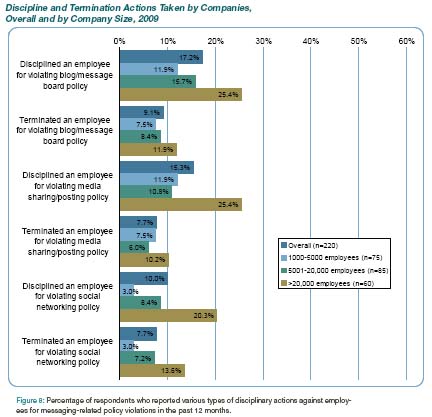
Employees should be more careful than ever about what sort of work-related information they post online. A new report indicates that companies are growing increasingly aware of inappropriate sharing, with many incidents resulting in someone getting fired.

Proofpoint found that businesses have definitely become wary about blogs. An official statement claimed that, during the past year, “17 percent disciplined an employee for violating blog or message board policies, while nearly nine percent reported terminating an employee for such a violation (both increases from 2008, 11 percent and six percent, respectively).”

It seems that firms are aware of YouTube and Facebook, as well. The report indicated that eight percent of corporations (each) got rid of people for violating policies pertaining to multimedia sites and social networks.

Finally, if employees figured they were safe using the relative newcomer, Twitter, they should think again. Proofpoint reported that 13 percent of U.S. companies investigated “exposure incidents” involving Twitter and Twitter-like services.

ProofPointSocialMedia

You might interpret this as evidence that people should learn to keep their mouths shut (and/or fingers still).  A more charitable view is that perhaps social media sites should make their privacy notices and options more visible.  Regardless, it looks like social media is starting to have a significant impact in the workplace.

You might interpret this as evidence that people should learn to keep their mouths shut (and/or fingers still). A more charitable view is that perhaps social media sites should make their privacy notices and options more visible. Regardless, it looks like social media is starting to have a significant impact in the workplace.

New Mobile Marketing Guidelines

Open for Public Review
By Chris Crum – Fri, 08/07/2009 – 14:12
To Be Published in September

Mobile marketing is going to become increasingly hard for businesses to ignore. Just look at how much mobile advertising is already going on.

The key of course (which could really be said of other kinds of marketing), is to not be annoying about it. WebProNews recently interviewed former Yahoo executive and current Chief Revenue Officer of mobile marketing firm Crisp Wireless, Tom Foran, about this.

There are some new guidelines for mobile marketing in the works from none other than the Mobile Marketing Association (MMA), whom I like to think of as kind of like the Interactive Advertising Bureau for mobile marketing. The MMA consists of agencies, advertisers, hand-held device manufacturers, carriers and operators, retailers, software providers and service providers, and other companies focused on marketing with mobile devices.

The MMA has opened up a public review period for the guidelines, which runs through the end of the month. They new guidelines will be published in September. News updates and additions to the guidelines include:

– The MMA’s new Universal Mobile Advertising Package (UMAP), which provides industry-standard ad units.

– The Mobile Application section has been expanded from North America only to worldwide.

– An expanded MMS section, including new ad units and guidelines.

– An expanded Mobile Video & TV section with new ad units and guidelines.

– An expanded Mobile Applications section with new ad units and guidelines

“The MMA’s Global Mobile Advertising Guidelines are designed to provide the timely, actionable guidance and insights necessary to continue mobile advertising’s phenomenal growth,” said Mike Wehrs, MMA president and CEO. “By making each new version of the Global Mobile Advertising Guidelines available for public review, the MMA ensures that this resource meets the needs of the entire mobile advertising ecosystem.”

eMarketer estimates that there will be 280.8 million mobile phone subscribers by the end of the year, while comScore says there will be 29 million smartphone users. Meanwhile, AdMob is getting ready to serve its 100 billionth mobil

Sidenote: See our interview with MMA President and CEO Mike Wehrs below:


Kelsey Media News

Kelsey Media – New Print Projects

KMP Print Services July/August 2009

Produced a tri-fold brochure for Kanu Hair Products for promotional use at hair salons and trade shows. Captured still images from Code51 Band video we produced that was used for their online banner and brochure.

KanuBrochmain

We specialize in print marketing collateral and signage that can provide impact and bring awareness to your event, product or business. We also specialize in Product Brand Design for all industries, which includes concept, creative design and product label requirements. We have an extensive background in design for the Food Service, Healthcare and Pharmaceutical industries. Visit and see some of our work

Hello world!

Welcome to our Blog… anything goes here!

About Us

Kelsey Media Productions – launched in 1991 we have been providing services to over hundreds of clients utilizing all formats of digital media and creative marketing. Stephen Cataldo founder and president of Kelsey Media Productions is a marketing communications specialist with deep experience in healthcare, food service, biotechnology and high tech industries. I have worked with senior-level executives at a wide range of companies, from start-ups to large corporations. I have designed and produced high quality multi-media products that addresses business issues wider than just marketing and communications.

Stephen’s background experience includes marketing, digital media, website design/development along with video and music soundtrack production. Working several years designing multimedia for corporations, retailers, government agencies, entertainment and nonprofit organizations. Stephen has worked with over a hundred clients to create graphics, design websites, animation, presentations, video, and print media, and has earned a strong reputation for his expertise, insights and effectiveness.